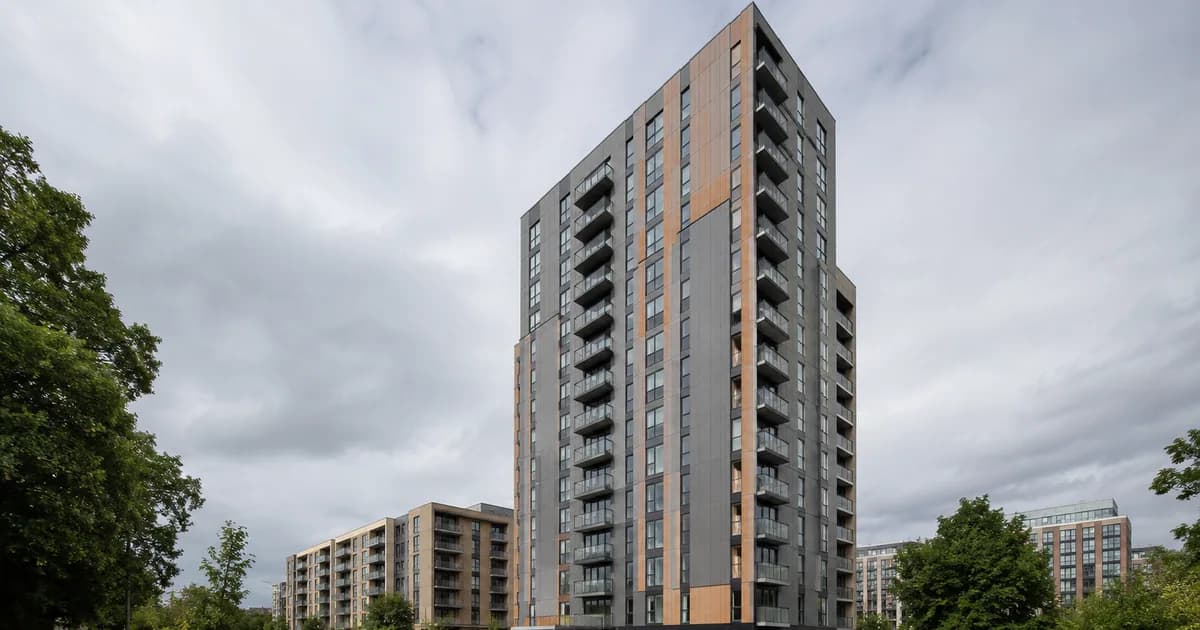
Five years after Grenfell, the cladding crisis is no longer at the top of the news. The legal and financial mess it created, however, is still very much active for leaseholders trying to sell flats. Here is where things actually stand in May 2026, what an EWS1 form does and does not do, and what your options are if your building has work outstanding.
What "cladding" actually means in 2026
The technical definition has crept beyond the original ACM (aluminium composite material) panels that failed at Grenfell. Lenders now treat any external wall system on a building over 11m as something that needs assessment. That includes:
- ACM rainscreen cladding (the original Grenfell-type)
- HPL (high-pressure laminate) cladding
- Other rainscreen systems with combustible insulation
- Curtain walling with combustible spandrels
- Timber cladding without a fire-stopped cavity
Stone, brick, render directly applied to substrate, and most concrete construction do not typically need an EWS1 because there is no external wall system in the lender's sense.
What an EWS1 form is
The EWS1 (External Wall System form) was created by RICS and major lenders in December 2019 as an industry workaround. It is filled in by a fire engineer and tells a lender whether the external wall system needs remedial work.
Two top-level grades, with sub-grades:
- A: no combustible materials. A1, A2, A3 depending on supporting evidence. Universally accepted.
- B: combustible materials present. B1 means remedial work not required; B2 means remedial work required.
A B1 used to be hard to get a mortgage on. As of 2026, most mainstream lenders (Halifax, Nationwide, Santander, NatWest, HSBC) lend on B1 with no special conditions. B2 still effectively kills most deals until remediation is done or contractually scheduled with a confirmed completion date.
The form is good for 5 years. It belongs to the building, not the flat. Your managing agent or freeholder commissions it, and every leaseholder benefits.
Government remediation: who pays
The legal landscape changed twice. The Building Safety Act 2022 introduced a leaseholder protection regime that sticks costs to the developer, the freeholder, or the government, never the qualifying leaseholder. The Leasehold and Freehold Reform Act 2024 closed loopholes.
You are a qualifying leaseholder if all four apply on the date the building was identified as defective:
- The lease started before 14 February 2022.
- The flat was your principal home, OR you own no more than 3 dwellings in total in the UK.
- The lease has more than 21 years remaining.
- The building is over 11m or has at least 5 storeys.
Qualifying leaseholders pay nothing for cladding-related remediation. Non-cladding building safety defects (internal compartmentation, fire doors, alarms) have a capped contribution: usually nil if your flat is worth under £325,000 (£1m in London), otherwise a sliding scale capped at £15,000 (£50,000 in London) over 10 years.
If you do not qualify, you are potentially exposed to the full cost. Buy-to-let landlords with more than 3 properties, or any leaseholder who bought after 14 February 2022, are non-qualifying. Some of these costs run to six figures per flat.
The current funding pots
Several government schemes pay for the actual remediation work, not for individual leaseholders' costs:
- Cladding Safety Scheme: for buildings 11m to 18m with unsafe cladding. Funded by the government via the Department for Levelling Up.
- Building Safety Fund: for buildings over 18m with unsafe non-ACM cladding.
- ACM Remediation Fund: for the original Grenfell-type ACM cladding.
- Developer Remediation Contract: signed by 50+ major developers, who agreed to pay to fix buildings they built.
Combined funding is over £8bn. Government pace has been criticised as slow but progress is real: as of early 2026, around 70% of identified buildings are either complete or have work scheduled.
Selling a flat in a building with confirmed remediation
This is the realistic case for most leaseholders. The building has been assessed, work is needed, and a remediation contract has been signed.
Buyers can get mortgages if you can show the prospective lender:
- The current EWS1 (showing B2 with remediation planned, or pending re-issue post-works).
- The signed remediation contract and works programme.
- A statement that the qualifying leaseholder protections apply (your lease start date proves this).
- Evidence the freeholder or developer is funding the works.
Some lenders will lend immediately. Others want the works completed before they will lend. The market is mixed but improving.
You will want a specialist solicitor on a complex sale. Conveyancing is much heavier than a vanilla flat sale, taking 4 to 6 months versus the usual 2 to 3.
Selling a flat with no EWS1 and no remediation plan
This is the bad case. If your building is over 11m and there is no EWS1, lenders treat it as B2 by default. Cash buyers exist but the discount is brutal: typically 25 to 40% below market.
Force the issue with your managing agent or freeholder. The Building Safety Regulator (operating since October 2023) has powers to compel buildings into the assessment process. Reporting an uncooperative freeholder has a real effect.
If you are in this situation and need to sell quickly, your realistic options are: cash buyer at a heavy discount, auction (similar discount), or a specialist cladding-affected flat buying service at typically 25 to 30% below market value.
If you can wait, the wait is usually worth it. The same flat with completed remediation typically sells within 5% of its uncladded comparables.
What buyers should ask before offering on a flat
Use these as your due-diligence questions before you go to offer:
- Is the building over 11m or 5 storeys?
- Is there a current EWS1, and what is the rating?
- If B2, has remediation been contracted? When does work complete?
- Is the qualifying leaseholder protection in place under the Building Safety Act?
- What service charges have been paid for fire safety in the last 3 years? (Indication of how active the building is.)
- Has a section 20 notice been issued for major works?
- What is the freeholder's track record on responding to fire safety reports?
Ask the seller's solicitor to provide all of this in the buyer pack. If they cannot, walk away or factor the uncertainty into your offer.
What sellers should do this week
- Find out if your building has an EWS1 and request a copy.
- If there is not one, push your managing agent to commission one. Pool with neighbours if needed; the cost is shared across the block (typically £3 to £15 per flat).
- Confirm your qualifying leaseholder status in writing with your solicitor.
- Do not list before you have the EWS1, the remediation plan, and the qualifying leaseholder confirmation in hand. Listing without them wastes weeks and tanks your asking price.
Sources
- Check if your home has cladding (gov.uk)
- Building safety leaseholder protections (gov.uk)
- Leasehold and Freehold Reform Act 2024
- EWS1 form explainer (Commons Library)
Per-property cladding check for tall flats
Our Premium report (£24.99) flags building age, height, and known cladding-affected blocks alongside title, lease length, planning, and 100+ other data points.
Get a Premium Report £24.99